Script
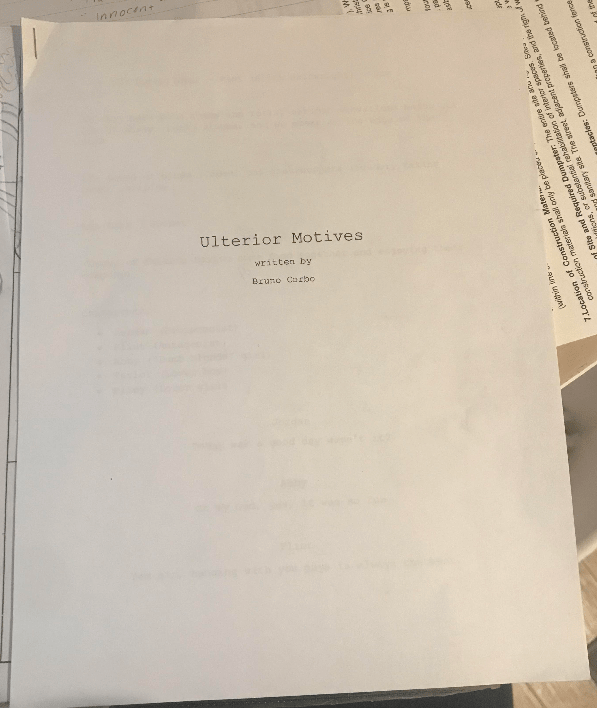
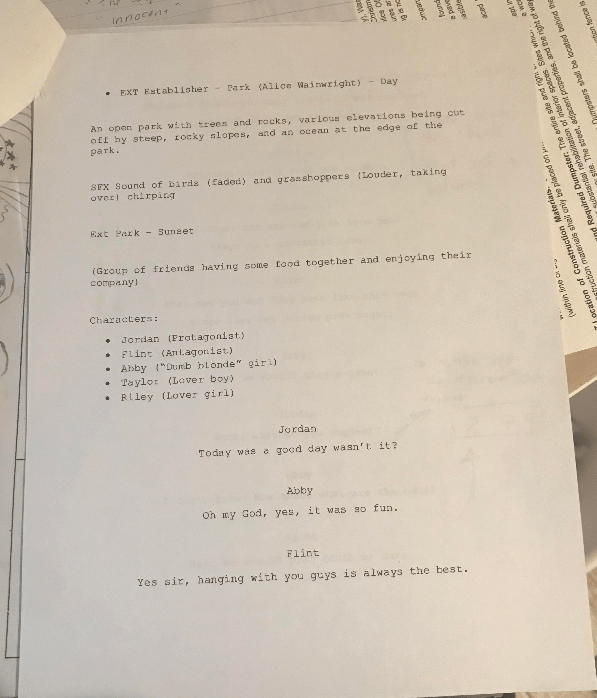
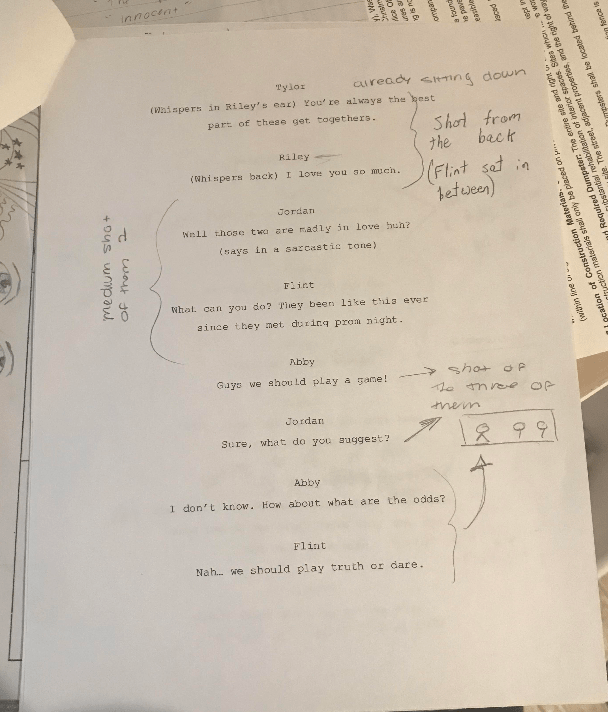
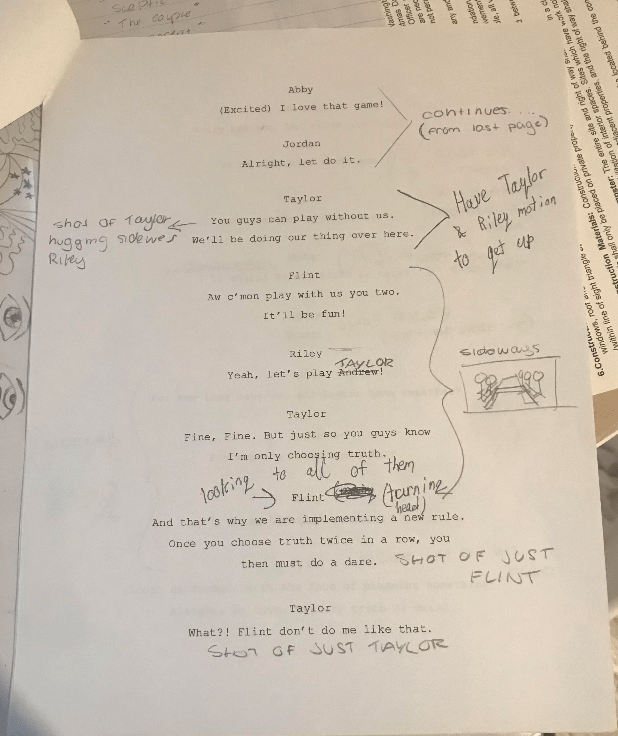
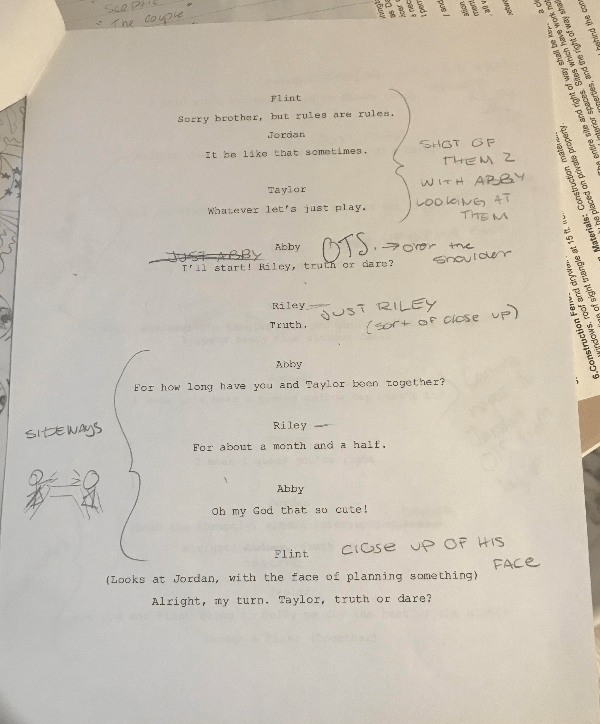
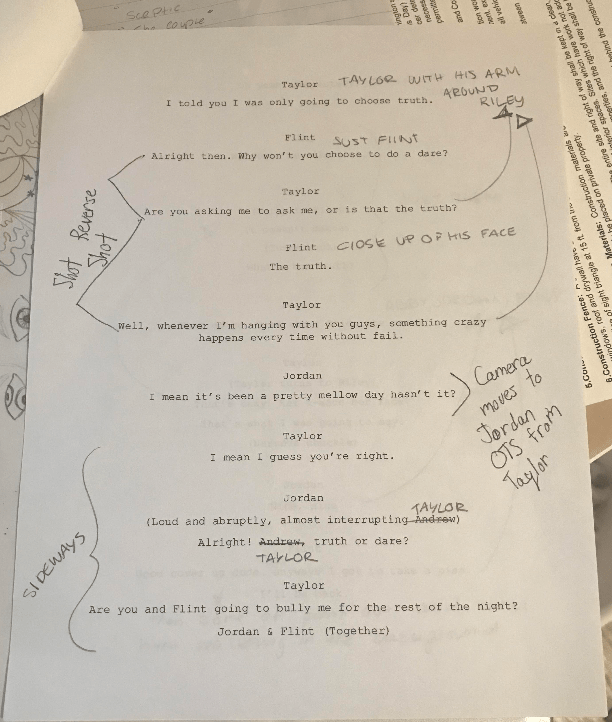
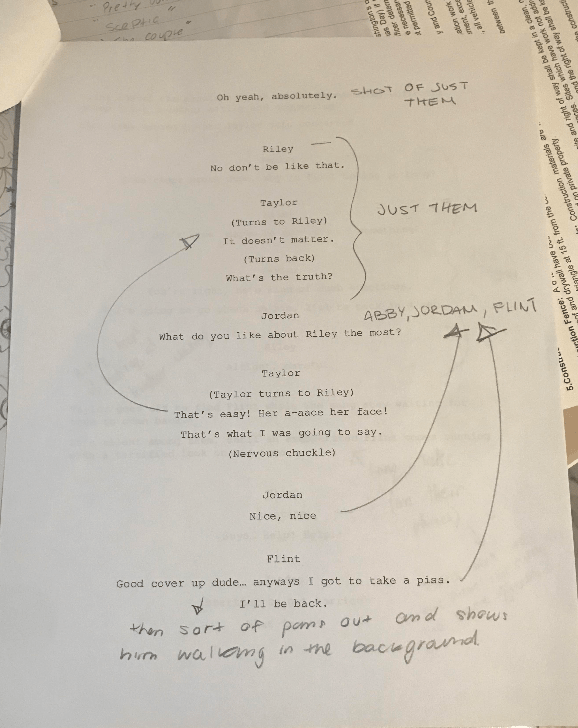
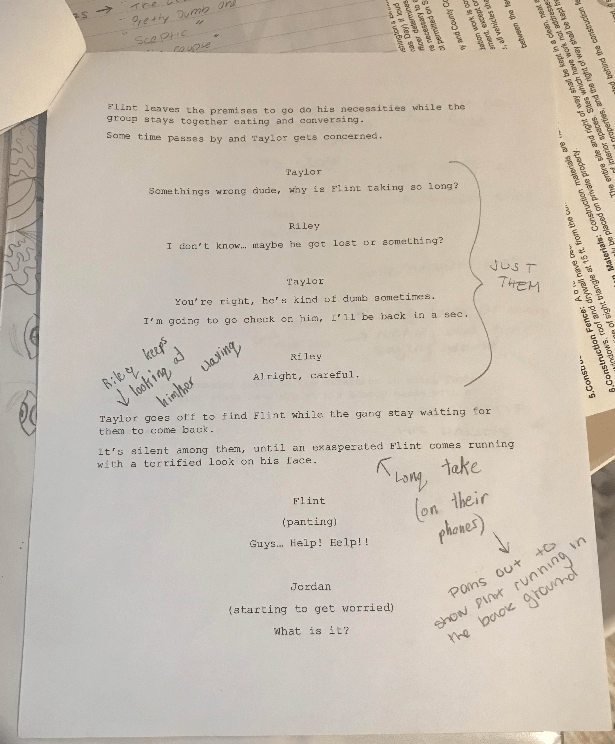
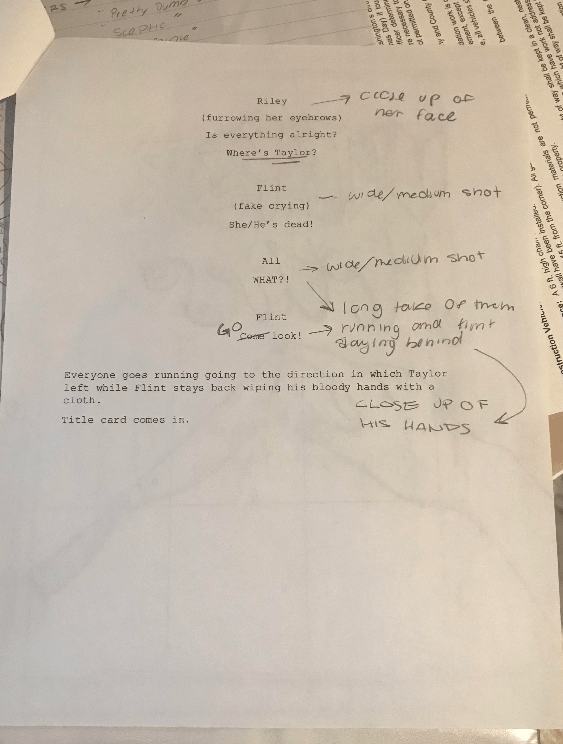
This is the script for the movie – Ulterior Motives – with some notes that the director and I made so I could get a concept for the storyboard, since I am in charge of that. Also since I’m one of the production designers, this would help me know what type of props I need to bring and what lightning I should use.
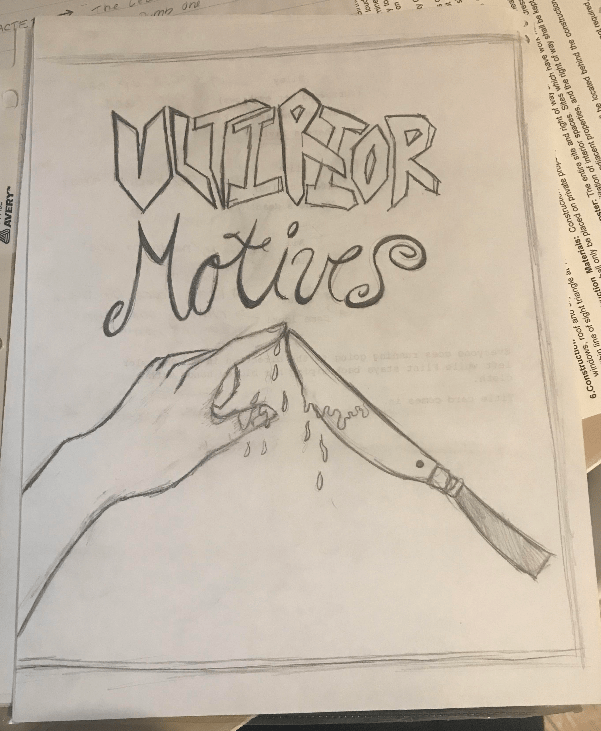
This is just a concept art I made for the poster of the film. I made it just for fun, I like to draw so, it was really cool to think of an idea for a poster.
Production Design
The production designer is in charge for creating and managing the visual aspects of a film, TV show or theater production.
They work with the director and producer collaboratively to create a design style according to them and what they would want they film to look like. They use the design for aspects such as sets, graphics, props, lighting and costumes. Later, they manage the team, responsible for producing these visual elements, like set and costume designers. To be a production designer requires extensive previous experience in the industry.
Usually they do the following:
- Determine Visual Styles – they read scripts to know what the visual styles is the most appropriate. They discuss their view with the director and producer to see their requirements, to later develop the actual style for the production.
- Provide Concept Drawings – based on the concept they could provide sketches to further communicate the idea they have to the director and art team. They do scale drawings of the sets, and draw ideas for costumes, props and make-up. They could also provide their input for special effects and graphic designers.
- Research Locations – they must research the filming locations and scout them; they could either be studios, public or private places. They must assess all of the, for the visual stability and practicality.
I am one of the assigned production designers for the film, so I would apply all this research into my work while on production.
Source : https://www.jobhero.com/production-designer-job-description/
Triangle Of Dependency
It is very important to meet the audience’s expectations while making a film. Since they are the reason why people even make films, it is important to take into consideration what to do to entertain them and make them want to watch your film. You are not going to make a movie for yourself, you make them so an audience to watch an enjoy and make more people want to watch the film.
So there is this tactic to utilize while making a movie called The Triangle of Dependency, sometimes called The Media Triangle, suggest that the media text, institution and audience all influence each other in a certain way.
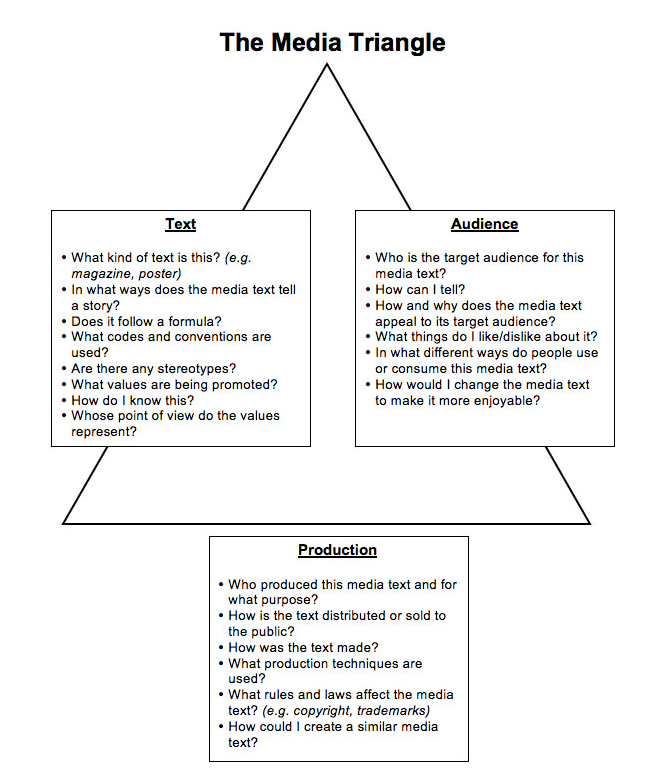
The institution will adapt their text according to what audiences want or need, otherwise they are not going to consume their product.
The audience will influence the text because it will be something that they would want to watch since research may have been done in order to find out what the viewer would want to watch.
While making a film, the institution are going to have to keep their audiences invested in their product; if a change in society occurs, they would have to adapt to the new society and its needs. They may need to change their text of it isn’t popular anymore.
If the movie is an a specific genre such as horror, it is important for the industry to keep up the audiences expectations of said genre; some people will want to watch a movie purely because of the genre, and if it doesn’t meet the conventions of it, audiences may not really enjoy the movie and leave a bad review of it because it doesn’t fulfill their expectations. If this is the case, the institution had been targeting the wrong audience and would have to change their genre that fits their stereotypes.
Source : https://educatorpages.com/site/ChristineFB/pages/lesson-2-media-studies
Why Do People Watch Horror Films?
Physical effects – people enjoy the excitement that horror generates in them, it makes them release endorphins, such as adrenaline, and people sometimes chase that feeling through watching scary films.
Emotion – people want to feel what the characters are feeling, like the terror, anxiety, fearful, panic, chased, cornered, etc. They want to have a connection or empathize with the protagonist/s. Some want to see the resolution in the end of the bad guy being taken down. They have the ability to pay a lot or little to nothing attention in order to control what effect it has on them.
To overcome fears – If they watch a ghost movie because they are terrified of them, by watching a paranormal film they might overcome that phobia/fear.
Intrigue – horror films sparks audiences attention due to it’s scary – sometimes ridiculous – subjects. The usually high exaggerated cases people have the opportunity to escape from their life and dive in into an artificial one. To escape from reality to a fantasy. Some people like to believe there are real ghosts out there, some like to believe there are vampires out there, and as ridiculous as it sounds, it is their escapade form the real world.
Voyeurism – they watch something that they wouldn’t normally. They try to go out of their comfort zone and watch something that they wouldn’t see in real life (unless it is a movie about an unhinged serial killer, because that can happen in reality).
Socializing – sometimes people just want to have a good time with friends and enjoy watching horror films together
Source : https://www.psychologytoday.com/us/blog/in-excess/201510/why-do-we-watching-scary-films
How Do You Keep Audiences Engaged? Part 2
I have decided to do an analysis of the opening scenes of my favorite movie – The Dark Knight– and my favorite TV show – Mr. Robot– to get the idea of how to keep audiences hooked to the screen with only watching the first few minutes of it. Since my project is based on doing the opening of a film, I think this would help me a great deal.
The show starts off with a dark screen and the main character talking to the audience as if they are friends. By having the establishing shot be a dark screen already has a sense of enigma to it. It also connotes to the darkness and loneliness that Elliot – the protagonist – is feeling.
Because he is so lonely, he continues saying that it is lame to be talking to an imaginary person that he has created, but he has a plan that he needs to let somebody know, but since he has nobody to talk to, he decides to create a friend, in this case that imaginary friend is the audience. So that alone already has people curious as to why he feels this way, as well as it builds a connection between character and audience, which contributes to audiences engagement in the show.

Then the camera starts to pan out of the darkness revealing an office of executives conversing as he says the line “there is a powerful group of people out there that are secretly running the world”, which connotes to them, they are the powerful group of people. By being one of the high floors of a building also signifies a hierarchy of how the rich are on top of the world and the poor are at the bottom of the food chain.
At first the camera is blurry on the men talking and focuses on a building in construction, this could connote to the plan Elliot is building in his head, the one that is top secret. Then the camera focuses on the executives as he says “I’m talking about the guys, no one knows the guys that are invisible”. He is putting the attention on them to signify they are bad, these are the guys we as a society should be fearing. It leaves audiences with that enigma, what have this people done to infuriate Elliot so much? To the point that he starts formulating to take them down. Further, the sense of mystery continues as Elliot states”now I think they’re following me”. Why does he think that? It makes audiences continue being engaged by making them question this guys decisions. Why is he so paranoid?
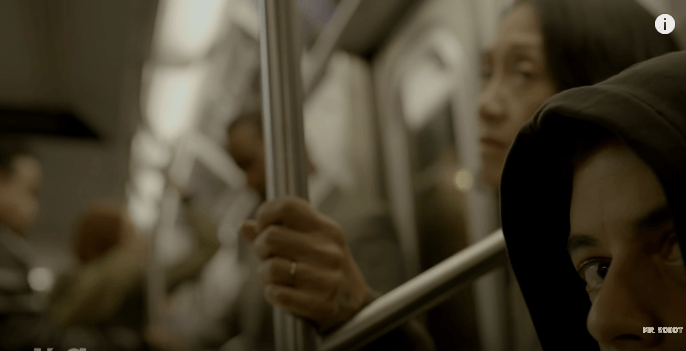
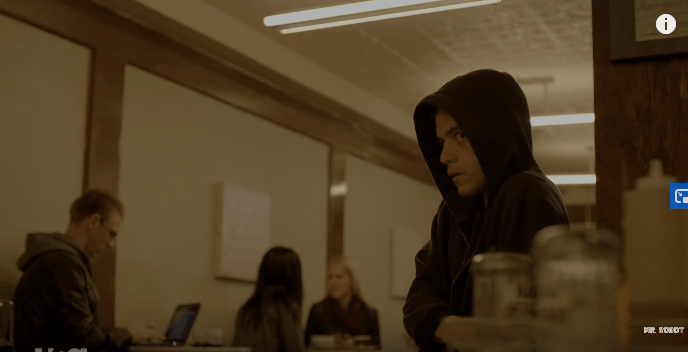
After he finishes his speech, it turns black back again until the sound of a train stopping comes as Elliot is with his hood up looking at two guys suits. He seems nervous and sort of out of place, like he doesn’t want to be there. The camera shots in the show are unconventional, they don’t follow the normal “rules” of camera shots. As shown in the image above, Elliot is in the corner of the frame instead of being front and center. This is the first time Elliot is shown, this is the first look the audience sees of him. The camera placement connotes to his shyness and discomfort of being in a public place to the audience.
He says that he should’ve gone to his friend’s – Angela – birthday party, put instead he went somewhere else, a coffee shop as it appears in the mise-en-scene. He doesn’t say where, but instead it is shown by a shot of him waiting of a man to sit down, so he can go and talk to him, for unknown reasons at the moment. The silence along the diegetic sounds of the shop, builds an uncomfortable feeling as he walks towards him nervously; the audience still wonders why is he there, and who is the man he is approaching.
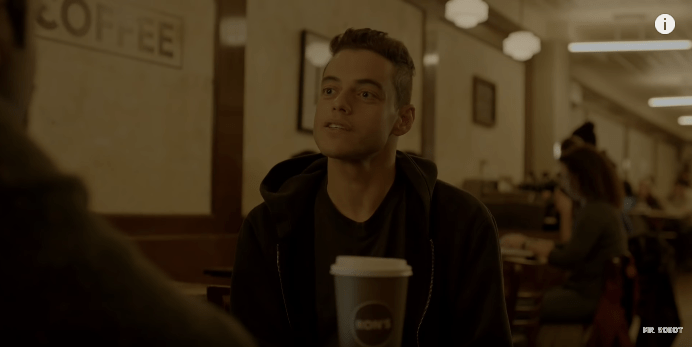
Elliot suddenly starts saying to him all this personal stuff about his life, such as how he is the owner of the shop, how he changed his name to Ron, how the internet in his shop is so good that it “scratched that part on his mind that doesn’t allow good to exist without condition”. So he decides to hack him. Here he gives demonstrates a lot about his personality, he is paranoid, nervous, and calculating. It keeps the audience interested in him and in Ron. What did he do that made Elliot so invested in him?
He reveals how he is control in the situation due to him having all the evidence of Ron’s illegal website. A robotic sort of sounds starts going as the conversation becomes more interesting, it helps build the tense and mysterious atmosphere of the scene. Then he reveals he is -despite what he knows about Ron- he is still empathetic; he says that he understands what is like to be different because he is very different, too. And then the scene cuts. This leaves audiences with so many questions about who is Elliot, why was he still so anxious to talk to someone if he was the one in control of the situation. The show is sort of establishing an anti-hero rather than a hero, a more relatable character that audiences would appreciate more, which also lead viewers engaged in the show.
By building an enigma around a character, camera placing, and voice-overs, Mr. Robot successfully keeps the audience engaged all throughout is opening. One is hooked since the first 3 seconds of the episode.
How Do You Keep Audiences Engaged? Part 1
I have decided to do an analysis of the opening scenes of my favorite movie – The Dark Knight- and my favorite TV show – Mr. Robot– to get the idea of how to keep audiences hooked to the screen with only watching the first few minutes of it. Since my project is based on doing the opening of a film, I think this would help me a great deal.
It first off starts with a wide shoot zooming in a dark building with a drawn out violin note; this helps creating an uneasy feeling to the audience, as well as it helps create atmosphere and suspense.
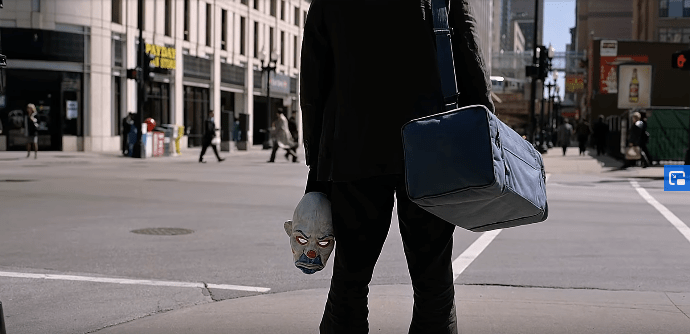
This medium shot slowly zooms on the mask to convey to the audience the importance of the person’s unknown identity. This creates a sense of enigma for the people wondering who this person is and what are they’re intentions.

There is this sign in the background that is a subtle detail that the director – Christopher Nolan – decided to incorporate to the film. The sign is confusing, which comes in line with the theme of chaos that comes hand in hand with The Joker. The effect of this sign is foreshadowing, The Joker is going to come and disrupt the equilibrium that Gotham City has had since the last disaster that occurred with Scarecrow, the previous villain; but in a much greater effect.
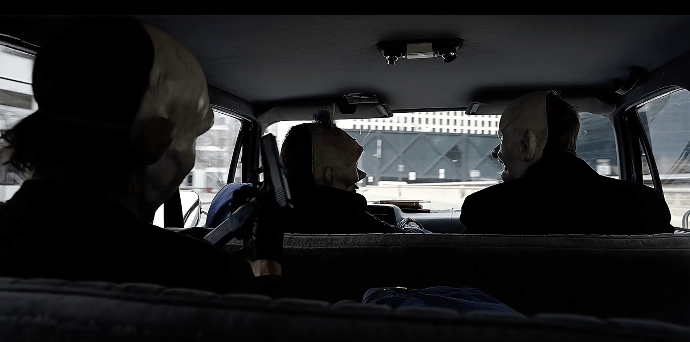
The dialogue in the scene the characters are talking about the Joker. They reveal everything that there is to know about him, but at the same time revealing nothing. What we know, according to the two guys in the car, is that The Joker is an amazing planner, he is feared by many, and that no one knows his identity, not even the people he hires. It creates this atmosphere of mystery that surround this person, making the audience more eager to know who this is, and whats the deal with them.
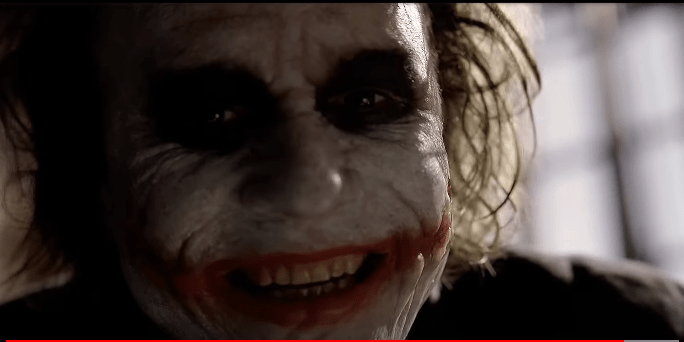
The close up of The Joker, with the violins in the background going form a higher note to a lower one that is a sinister impression of him, the audience already know what he is capable of due to the build up from the beginning. The camera is positioned in a low angle , not only to demonstrate POV shot of his victim, but also demonstrate his power he has over him.
The viewers don’t get to see The Joker until he takes off his mask 4:20 minutes into the film. Christopher Nolan managed to capture a sense of mystery around this character through dialogue of other characters taking about him, camera movement, and music. I would take that into consideration while making my film opening.
How to use costumes and make-up effectively
The costumes and make-up in horror are super important since they can be broken down into parts.
What filmmakers want their audiences to differentiate the protagonist with the antagonist; they will try to make it obvious for the audience to know which side they should be rooting for. They want them to feel at the edge of their sit throughout the movie.
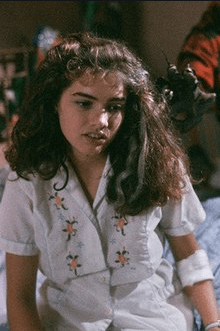
Further, if the protagonist are on the weaker side they will feel sorry for them more easily, and if anything bad happens to them they’ll feel even worse. Audiences will be able to be pulled into this fantasy world where they genuinely care about the wellbeing of the fictional characters; which makes the film more impactful in the long run.
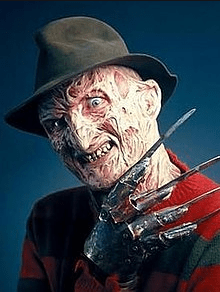
Verisimilitude – the appearance of being true or real.
It is important for a film to have verisimilitude because it stands for he appearance of reality or truth. For instance, if a film resorts into using unrealistic concepts that have been done countless of times on their project, it will ruin the movie for audiences, they will be sort of pulled out of the film since they know it is unrealistic. However, with twice as good make-up and costume designs the movie will seem more scary since the make-up is more realistic.
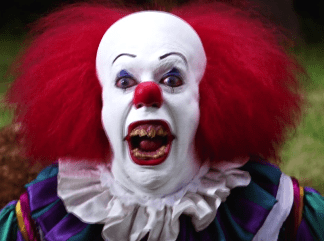
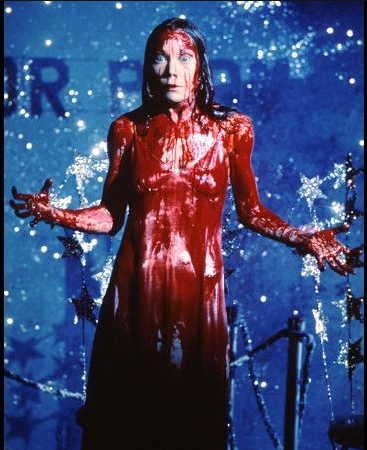
To use make-up and costumes effectively, movies need to support stereotypes that audiences already associate with. For instance, if a character gets hurt badly on one part of their body, viewers know that must be excruciating and they will be cringing thinking of how much that would hurt; it is the make-up and especial effects team to make it seem realistic by applying certain amount blood on the wound according to how big it is; which could leave audiences feeling nearly sick. If blood is splattered on their face it means that they are in great danger. And since make-up artist possess more resources than before, such as technology, the final product is much better bringing more emotion out of audiences.
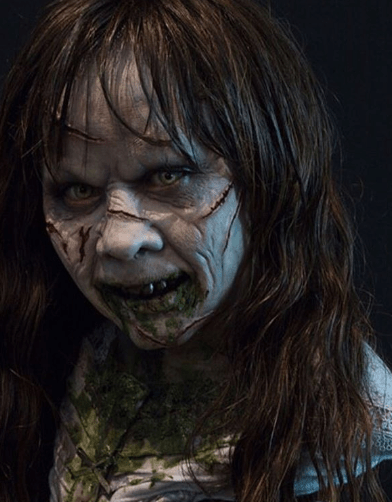
Characters will look as human as possible through make-up and costume trickery. Costume designers want the audience to be scared; so the y will have a ghost dress in white to make them look innocent, like they couldn’t hurt a fly because the thought pf having someone unassuming commit horrible murders is terrifying. The skin on display will look completely pale but their eyes; they want to make them seem real.
Source: https://cine-vue.com/2018/04/why-costumes-and-make-up-are-still-so-important-to-horror-films.html
Concept Idea/Brainstorming
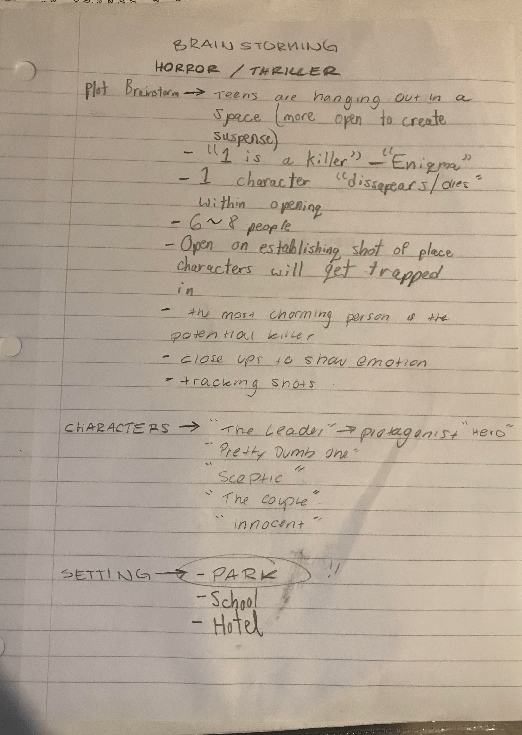
This is my group and I’s brainstorming for the final product.
At the end, we all agreed on doing a film about a group of friends hanging out in a park, until one of them dies/disappears.
TYPICAL HORROR LOCATIONS
A creepy mansion
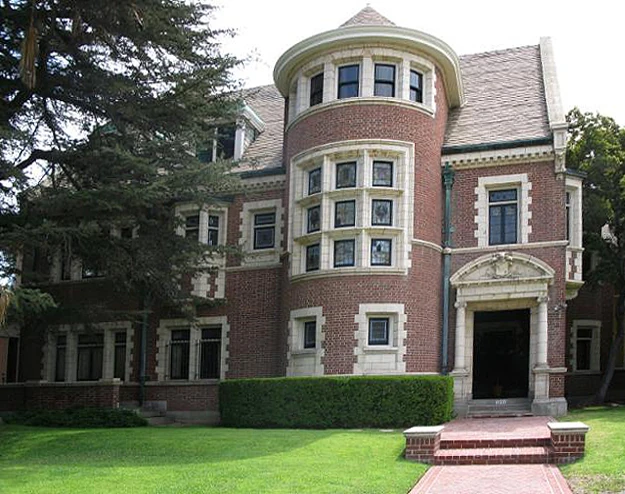
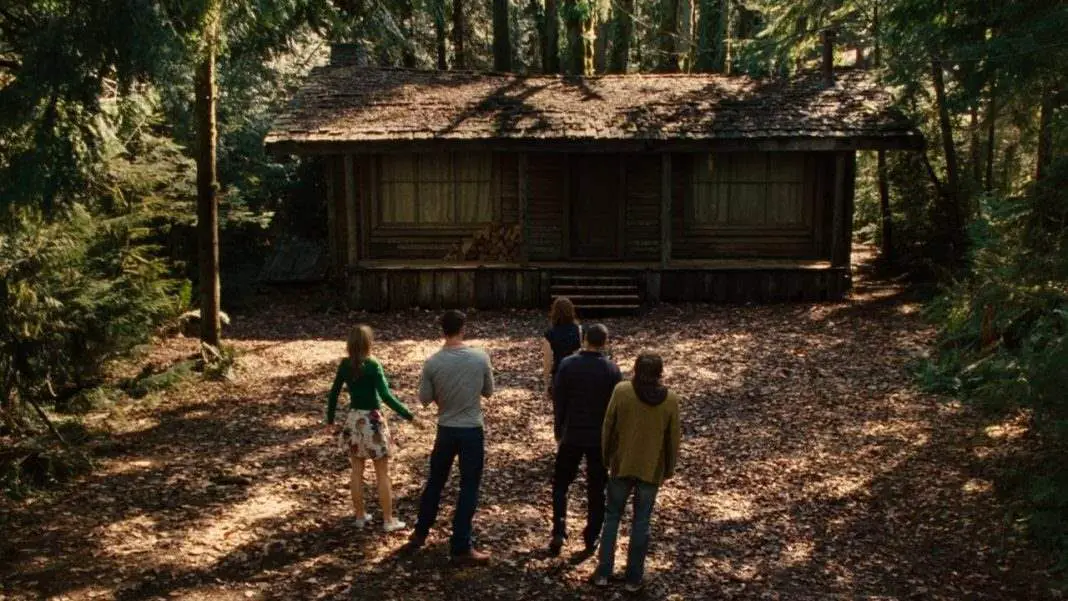
Isolated house, preferably in the middle of the woods.
A ghost town

Asylums

 AS Media Studies